Sustainability solutions from Panda
How can CO2 emissions be measured and reduced easily?
ESG stands for Environmental, Social and Governance. Reporting has to cover these three topics (pillars). In short, the three pillars cover the following:
- Environmental: environmental practices, such as carbon dioxide emissions, energy efficiency and waste management. Panda energy management supports the environmental pillar!
- Social: social responsibility, such as employee wellbeing, workplace diversity and community initiatives.
- Governance: corporate governance aspects, such as company culture, management and risk management.
ESG criteria are gaining ever more weight in today's corporate world. They are not limited to environmental practices: they also cover social responsibility and corporate governance. Commitment to sustainability is no longer optional, it is an essential part of modern business strategy.
Would you like to improve your company's sustainability?
Panda sustainability solutions
Panda supports companies in optimising energy consumption and CO2 emissions, thereby contributing to reaching environmental targets and improving sustainability.
This way companies not only protect the environment but also increase their business value, while making a positive social impact. Panda supports the environmental pillar (Scope 1 and 2 emissions).

How does Panda support the reduction of carbon emissions?
- Environmental data for sustainability reports: the Panda software automatically collects and supplies the environmental data required for sustainability reports, for example information on CO2 emissions, making the preparation of those reports much easier. More information >>
- Carbon dioxide emission analysis: the Panda software analyses a company's CO2 emission data, making it possible to track emission trends and efficiency and to identify opportunities for reduction. More information >>
- Green communication with the Panda Display: the Panda Display gives companies a way to communicate their sustainability results transparently to the public, strengthening their environmentally conscious image. More information >>
- Support in setting GHG reduction targets: the Panda software helps companies define and track targets for reducing greenhouse gas emissions, supporting the design of effective reduction strategies. More information >>
The environmental pillar
When measuring greenhouse gas emissions, companies sort their emissions into three main categories, which help them determine and manage more precisely the environmental impact coming from different sources:
- Scope 1: direct emissions from assets owned or controlled by the company. Examples: operating a vehicle fleet, industrial combustion processes, the use of boilers.
- Scope 2: indirect emissions from the use of purchased energy (electricity, district heating, district cooling). Examples: heating offices with district heat, electricity used in production processes.
- Scope 3: every other indirect emission in the supply chain, including upstream (e.g. sourcing raw materials) and downstream (e.g. use of products and end-of-life treatment) processes. Examples: emissions produced by suppliers, emissions from the use of products.
Panda energy management solutions provide support in reducing Scope 1 and Scope 2 emissions, including data reporting, optimisation of consumption and thereby the reduction of CO2 emissions. Whether it is electricity, gas, district heating or fuel, Panda helps companies operate more sustainably.
Automatic data supply for sustainability reports
The Panda software is an excellent tool for supplying the data needed for sustainability reports — in particular information on CO2 emissions — automatically. Panda automatically downloads and processes the invoices and the hourly (time series) data arriving from the providers, and it can also integrate fuel consumption, solar production and other data sources.
With the powerful data collection and analysis capabilities of the Panda software, companies get an accurate picture of their current energy efficiency and emission levels. This allows them to develop more sustainable business practices.
In sustainability reporting the Panda software is especially useful, because it helps companies present the required data transparently and consistently, which is essential for convincing investors and regulators. The software therefore not only makes data reporting easier, it also helps companies measure and improve their environmental performance.
Would you like to track your organisation's CO2 emissions?
Carbon dioxide emission analysis
Carbon dioxide emission analysis is a key part of a company's sustainability strategy. It includes analysing data going back several years, which lets companies understand and track the trends in their emissions and their efficiency over time.
Specific carbon dioxide emission analysis
An important element is the use of specific analyses, for example measuring CO2 emissions per guest night or per product manufactured. These analyses help companies pinpoint the areas where the greatest gains in emission reduction can be achieved.

Fuel registry module
A comprehensive sustainability analysis of a company must take the CO₂ emissions of the vehicle fleet into account. The Panda fuel registry module lets the consumption data of the fleet flow into the system automatically, where it can be analysed in detail. The module makes it easier not only to keep track of costs and quantities, but also to identify consumption trends and anomalies.
Monitoring and analysing solar production
The Panda software makes it possible to monitor and report on the production of solar systems continuously. Companies can easily follow how much energy they produced and how much they saved by reducing carbon dioxide emissions. The system also watches for outages and production losses, so maintenance needs and faults can be identified in time. The analyses not only make current production data understandable, they also help optimise the long-term solar strategy.
Analysing the impact of investments and projects
The impact of technological improvements and operational changes is an important aspect of the analysis as well. Companies can evaluate how these factors influence their emissions and what steps they can take towards more sustainable operation. The analysis therefore allows not only an assessment of the current state, but also the grounding of future strategies.
Support for GHG reduction proposals
The Panda software provides support in drawing up and following proposals for reducing GHG (greenhouse gas) emissions. The system helps identify the main carbon emission points of the property portfolio, opening the way to targeted reduction measures.
The software can also make proposals that require no investment for reducing GHG emissions, which can deliver quick savings. It also supports detailed analysis of emission data, helping companies map efficiency opportunities and design reduction strategies.
With carbon dioxide emission analyses, commitments can be tracked in the software, allowing continuous monitoring of GHG targets and a transparent presentation of the results. Panda is therefore not merely a data collection tool: it also helps companies define practical steps with which they can effectively reduce their environmental footprint.
Green communication with the Panda Display
The Panda system helps not only with data collection but with green communication as well. With the Panda Display, companies can present their sustainability results, increasing transparency and strengthening their brand.
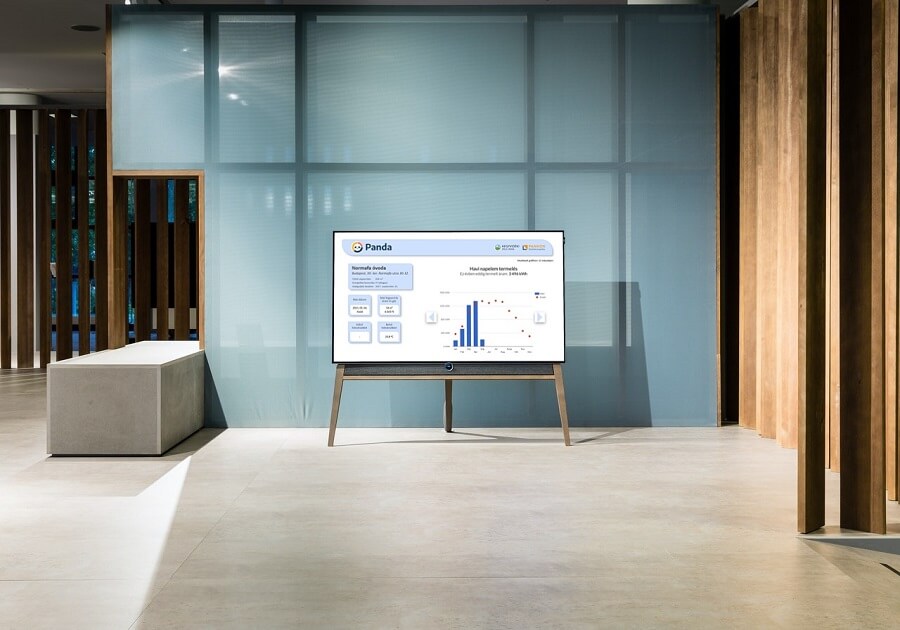
It's Not Enough to Be Green, You Have to Look Green Too
The Panda Display™ provides your organization with a branded interface that showcases your sustainability efforts.
- Sustainability reporting and awareness
- Visualization of data from smart meters
- Communicate your organization's energy efficiency!
Request a Free Online Demo!
Book an appointment now to see how the Panda software works and assess your organization's needs.
Learn how Panda works in our video!
Contact Information
 Company:Pannon Építőműhely Kft.
 Phone:+ 36 1 203 2710
 Email:panda@pannonmuhely.hu
 Address:1117 Budapest, Szerémi út 7/A
Request a Free Online Demo!
Book an appointment now, so that we can show you how Panda software works and assess your organisation's individual needs.